Rewarded ads
Rewarded ads are units with Combinatorial or video ads used for monetizing games. The unit fills the entire screen of the app. For watching an ad, the user gets a reward or in-game currency. To get the reward, the user needs to view:
View duration — 30 seconds.
View duration — full video.
When creating or editing a rewarded unit in the interface Boost you can specify the in-game currency and set the reward amount for viewing the ad in full for the first time.
Creating ad blocks
-
In the main menu, go to Ad Monetization → Applications. Click next to the app in the Ad units column and select Add.
-
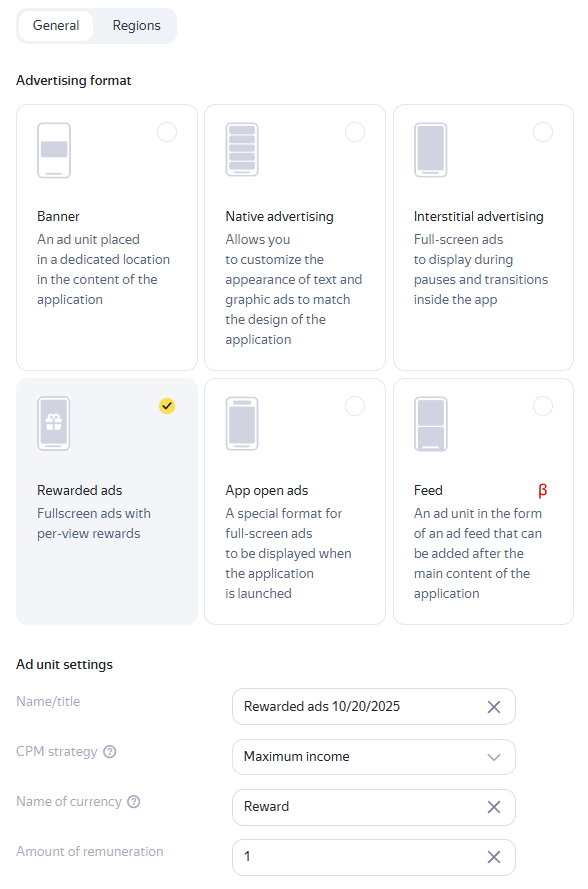
Select the Rewarded ad format.
-
Enter a name for the ad unit — it'll make it easier to find the unit in the interface Boost.
-
Define CPM settings. In the CPM strategy field, select:
-
Maximum revenue: If you don't want to limit the cost of an impression in the ad unit.
-
eCPM floor: If you want to set the minimum cost of an impression in the ad unit. When selecting this option, also specify the floor value in rubles, US dollars, or euros. You can change the floor currency in your account settings.
How it looks in the interface
-
-
Specify the currency name and a reward amount for viewing the ad in full for the first time.
-
If you're creating a unit for Yandex Mobile Mediation, integrate third-party ad networks.
How to connect third-party networks to a unit
-
In the ad unit settings at the bottom of the page, click Add network.
-
Select the mediation type: In-App Bidding or Smart Waterfall. A list of networks that support the selected type of mediation will appear.
-
Select an ad network and set the parameters of ad units created in the interface of this advertising network:
-
Currency: The currency of the CPM floor set for an ad unit from the external ad network.
-
App and ad unit IDs from the external ad network that you got in Step 1. Fill in the following fields based on the ad network you've selected:
Yandex Advertising Network
Type of mediation
App IDs
Unit IDs
BIGO Ads
In-App Bidding, Smart Waterfall
App ID
Slot ID
Google AdMob
Smart Waterfall
—
Ad Unit ID
Liftoff (ex. Vungle)
In-App Bidding, Smart Waterfall
App ID
Placement ID
Mintegral
In-App Bidding, Smart Waterfall
Placement ID, App ID, AppKey
Unit ID
Start.io
Smart Waterfall
Account ID, App ID
Ad Tag
VK Ads (ex. myTarget)
In-App Bidding, Smart Waterfall
—
Placement ID
-
eCPM: The CPM floor for the added unit (only for networks connected via Smart Waterfall).
-
-
If necessary, set the unit serving geography: go to the Geography tab and specify the CPM floor for selected regions.
-
-
Click Save.
The new unit with a unique ID will appear in the list on the app page. The unit ID (
ID) consists of the product ID (R-M), app ID (PAGE_ID), and the unit index number.Note
One app can have no more than 200 active ad units. Move unused units to the archive. If you need to add more than 200 units, contact support.
-
Integrate the ad unit into the app depending on the monetization method:
- To serve ads from the Boost only, follow the instructions to integrate the unit:
- To serve ads within Yandex Mobile Mediation, integrate the unit using the instructions:
- If you're using third-party mediation, connect the unit to the unit created for the Boost in a third-party mediation service.
For more information about integrating ad units, see Monetization methods.
-
In the main menu, go to Ad Monetization → Applications and open the app page. Under the app name, click New ad unit.
-
Select the Rewarded ad format.
-
Enter a name for the ad unit — it'll make it easier to find the unit in the interface Boost.
-
Define CPM settings. In the CPM strategy field, select:
-
Maximum revenue: If you don't want to limit the cost of an impression in the ad unit.
-
eCPM floor: If you want to set the minimum cost of an impression in the ad unit. When selecting this option, also specify the floor value in rubles, US dollars, or euros. You can change the floor currency in your account settings.
How it looks in the interface
-
-
Specify the currency name and a reward amount for viewing the ad in full for the first time.
-
If you're creating a unit for Yandex Mobile Mediation, integrate third-party ad networks.
How to connect third-party networks to a unit
-
In the ad unit settings at the bottom of the page, click Add network.
-
Select the mediation type: In-App Bidding or Smart Waterfall. A list of networks that support the selected type of mediation will appear.
-
Select an ad network and set the parameters of ad units created in the interface of this advertising network:
-
Currency: The currency of the CPM floor set for an ad unit from the external ad network.
-
App and ad unit IDs from the external ad network that you got in Step 1. Fill in the following fields based on the ad network you've selected:
Yandex Advertising Network
Type of mediation
App IDs
Unit IDs
BIGO Ads
In-App Bidding, Smart Waterfall
App ID
Slot ID
Google AdMob
Smart Waterfall
—
Ad Unit ID
Liftoff (ex. Vungle)
In-App Bidding, Smart Waterfall
App ID
Placement ID
Mintegral
In-App Bidding, Smart Waterfall
Placement ID, App ID, AppKey
Unit ID
Start.io
Smart Waterfall
Account ID, App ID
Ad Tag
VK Ads (ex. myTarget)
In-App Bidding, Smart Waterfall
—
Placement ID
-
eCPM: The CPM floor for the added unit (only for networks connected via Smart Waterfall).
-
-
If necessary, set the unit serving geography: go to the Geography tab and specify the CPM floor for selected regions.
-
-
Click Save.
The new unit with a unique ID will appear in the list on the app page. The unit ID (
ID) consists of the product ID (R-M), app ID (PAGE_ID), and the unit index number.Note
One app can have no more than 200 active ad units. Move unused units to the archive. If you need to add more than 200 units, contact support.
-
Integrate the ad unit into the app depending on the monetization method:
- To serve ads from the Boost only, follow the instructions to integrate the unit:
- To serve ads within Yandex Mobile Mediation, integrate the unit using the instructions:
- If you're using third-party mediation, connect the unit to the unit created for the Boost in a third-party mediation service.
For more information about integrating ad units, see Monetization methods.
Actions with units
In the main menu, go to Ad Monetization → Ad Units. Pick an ad unit from the list and select the necessary action:
- Duplicate: Create another unit in the ad unit list with the same settings but with a different ID.
- Send to archive: Send the unit to the archive. To restore an ad unit, find it using the status filter and click Restore.
Regional settings
You can restrict ad impressions in a unit for app users from a specific region. To do this, open the ad unit on the app page or in the ad unit list and go to Regions.
In the region tree, select one or more regions. Set the eCPM floor in selected currency without VAT in the eCPM field. Subregions inherit the CPM floor from the top level region.
To fully disable ad impressions in a region, select it and choose the Block option.
Cost per one thousand viewable impressions of an ad unit. An impression is considered viewable if at least one pixel of the ad unit was in the viewable area of the screen.